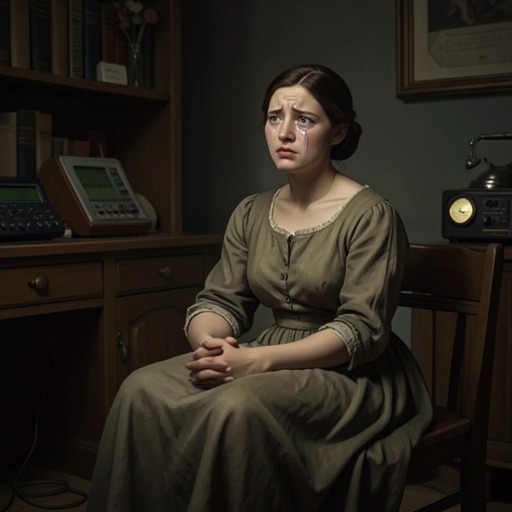
Nella and Mariano’s suspected affair
The Lying Life of AdultsNella and Mariano’s suspected affair is a relationship Giovanna can neither prove nor dismiss: she sees his legs pressed against her mother’s ankle beneath a dinner table, then watches them exchange a charged farewell, and carries those gestures into a new, jealous scrutiny of Nella. The suspicion matters less as a confirmed secret than as a rupture in Giovanna’s belief that her mother’s body and attention belong securely within the family. It turns looking into both an act of discovery and a source of distortion, as Giovanna’s imagination fills the gaps her evidence cannot close.
The adults and the child’s vantage
Mariano has long been part of Giovanna’s family life. He and her father have been friends since university, and he visits often, spending hours talking with him. A university history teacher and regular contributor to a prominent Neapolitan journal, he also brings an abrasive, combative style into the household: he rails against enemies in Naples, Rome, and elsewhere whom he believes obstruct his work. The children understand little of the adults’ arguments, but they have grown up treating their father and Mariano’s intellectual preoccupations as serious, demanding matters. They are also drawn to the Neapolitan obscenities Mariano uses, in part because their parents forbid them from speaking dialect or swearing.
That background makes the dinner-table scene harder for Giovanna to interpret. She knows Mariano as her father’s friend and as a loud, joking presence among adults; she has no adult language for the intimacy she glimpses. Her viewpoint remains low and incomplete: after throwing herself backward to avoid a ball, she lies on the floor and sees the adults largely in profile, registering legs and feet beneath the table rather than a full exchange of faces. In that narrow field of view, Mariano stretches his legs under the table and squeezes one of Nella’s ankles between his. The movement may be playful or illicit; the scene does not settle which.
Giovanna sits up abruptly, overcome by an obscure sense of shame, and throws the ball back toward Ida. A few minutes later she lies down again. Mariano still has his legs stretched out, but Nella has pulled hers away and turned her whole body toward her husband, remarking that it is still warm in November. The change in posture offers no explanation. It is precisely the mixture of a visible touch and an unknowable meaning that gives the episode its force.
A farewell that does not resolve the suspicion
For the rest of the evening Giovanna keeps watching her mother and Mariano. Nella barely participates in the conversation and exchanges no glance with him; she looks toward Costanza or her husband, but seems occupied by urgent thoughts. Mariano, by contrast, repeatedly watches Nella’s feet, knee, and ear with a sullen, melancholy expression unlike his usual aggressive chatter. When they do speak, she answers in monosyllables, while he addresses her in a low, caressing voice that Giovanna has never heard from him before.
The adults’ arrangements for the night add another layer of tension. Angela asks that Giovanna stay over, as she often does. Nella hesitates, and Mariano intervenes, pointing out that there is no school the next day and offering to bring Giovanna home himself before lunch. To the child, the exchange seems to carry an unspoken meaning: Nella’s resistance feels weak, Mariano’s request urgent, and both appear to be negotiating something beyond the practical question of where Giovanna will sleep. That interpretation is still only a child’s inference, not confirmation of a relationship.
When the parents finally leave, Nella kisses Costanza on both cheeks, with conspicuous smacks that seem to Giovanna to reaffirm their old pact of friendship. At the door, Nella appears to remember that Mariano is behind her and falls back against his chest as if fainting. While Giovanna’s father is still praising dinner to Costanza, Nella turns her head and offers Mariano her mouth. Giovanna thinks they may kiss like people in the movies, but Mariano touches Nella’s cheek with his lips, and she does the same to him. The gesture is intimate in its staging and ambiguous in its completion: it shows contact, not what the adults understand that contact to mean.
From observation to jealous interpretation
After the parents depart, Mariano and Costanza clear the table and send the children to get ready for bed. Giovanna cannot stop revisiting what she saw. She considers whether the ankle-touch was innocent play, a deliberate illicit act by Mariano, or an act involving both adults. The questions multiply rather than resolve: why would Nella tolerate the contact, when she has said she dislikes Mariano? How long had their legs been together? Why had she not pulled away immediately? The episode gives Giovanna details, but no access to the adults’ intentions.
In the dark, Giovanna decides that she will not tell Vittoria what she has witnessed. Vittoria has urged her to look closely and report what she sees, but Giovanna expects her aunt to impose a degrading interpretation, using the sexual language associated with her own history with Enzo to condemn Nella and thereby wound Giovanna’s father. The refusal is not a decision that nothing happened; it is a decision that Vittoria’s way of explaining it would be worse than uncertainty. Giovanna knows she has seen something, yet resists surrendering its meaning to someone whose hostility toward her father could turn suspicion into accusation.
The next stage is a sustained watchfulness. Giovanna attends to Nella’s behavior for days: when the telephone rings and her mother hurries to answer, then lowers her voice, Giovanna suspects Mariano is calling. When Nella spends unusually long choosing among dresses and asks Giovanna which one looks best, the girl imagines that she is preparing for a secret meeting with a lover. The evidence is now no more conclusive than the ankle beneath the table, but Giovanna has begun to arrange ordinary actions into a pattern.
Jealousy, family loyalty, and uncertainty
Giovanna describes the change as the discovery that she can become incurably jealous. Until then, she had taken Nella’s availability for granted. Her parents’ intimacy belonged to the ordinary order of the world: they slept together, kissed, and had conceived her, as she had been taught. That established relationship had not consciously troubled her. What she had not understood was her own possessive claim on her mother beyond the marriage: Nella’s body, perfume, and thoughts had seemed to Giovanna to belong to her alone.
The suspicion that Nella might be giving herself to someone outside the family makes that possessiveness visible. Giovanna imagines Mariano’s touch and saliva, and gives the conjectured affair a physical vocabulary that exceeds what she has seen. She associates Nella’s breathlessness with household and work duties, but now reads light in her eyes, imagined marks of Mariano’s hands beneath her clothes, and even the smoke smell on her, although Nella does not smoke, as signs of his presence. Her perception shifts from a specific observed gesture to a totalizing interpretation of her mother’s body.
That expansion is inseparable from fear of losing the familiar mother. Giovanna still wants to sit on Nella’s lap, play with her earlobes, and laugh together, even as touching her begins to repel her. She cannot find a good reason for what she takes to be betrayal and tries to imagine returning Nella to the time before the contact under the table, when her mother’s care seemed simply assured. The relationship’s central fact therefore remains unsettled: the narrative records Giovanna’s evidence and escalating conviction, but the supplied scenes do not establish that Nella and Mariano are lovers. What they establish is the lasting effect of suspicion—a child’s family intimacy transformed into a field of signs she watches, fears, and cannot conclusively read.